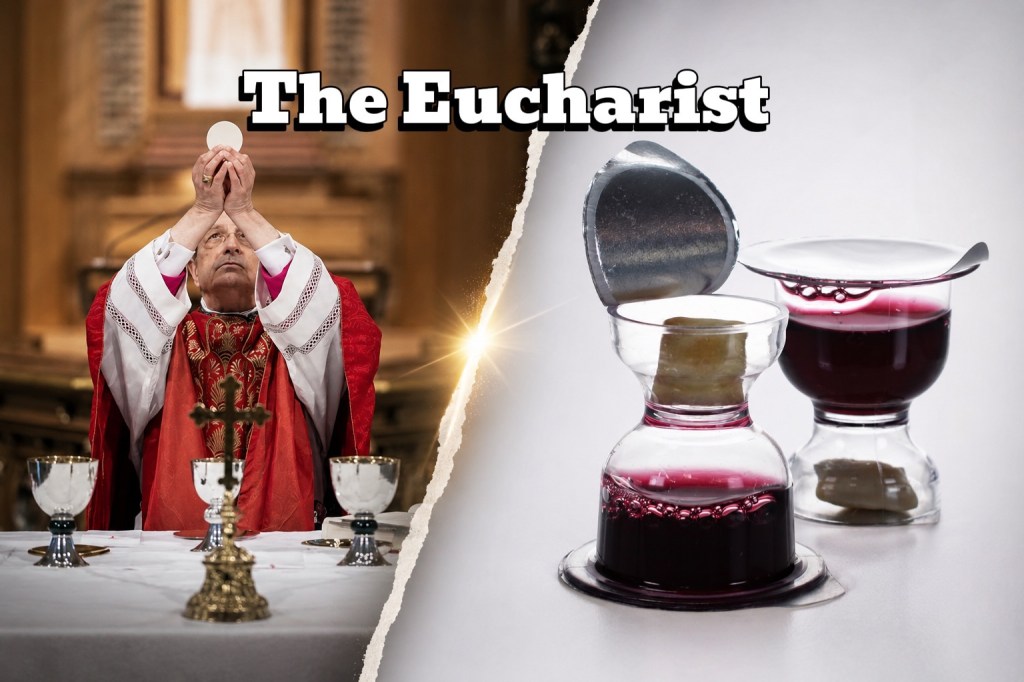
Communion or the Eucharist is a very controversial topic within the church. The church as a whole between the different traditions has the Eucharist (communion) on a scale. On one end there is the symbolic view which believes the Eucharist is nothing more then just a remembrance of Christ and nothing more to it no spiritual or physical presence is there. This view originated from Zwingli post the Protestant Reformation.
Then there is the Roman Catholic view on the opposite side of the spectrum. The Catechism of the Catholic Church in (CCC 1376) states the bread and wine of the Eucharist changes its physical state into the literal body and blood of our lord Christ Jesus. They believe the molecules of the bread and wine become the flesh and blood of Christ hence Trans(change)-Substance (transubstantiation).
I do not hold to either side, there are a lot of people who thinks it’s black and white and there is no middle point. Well there is, like i said it isn’t one side or the other it’s a spectrum.
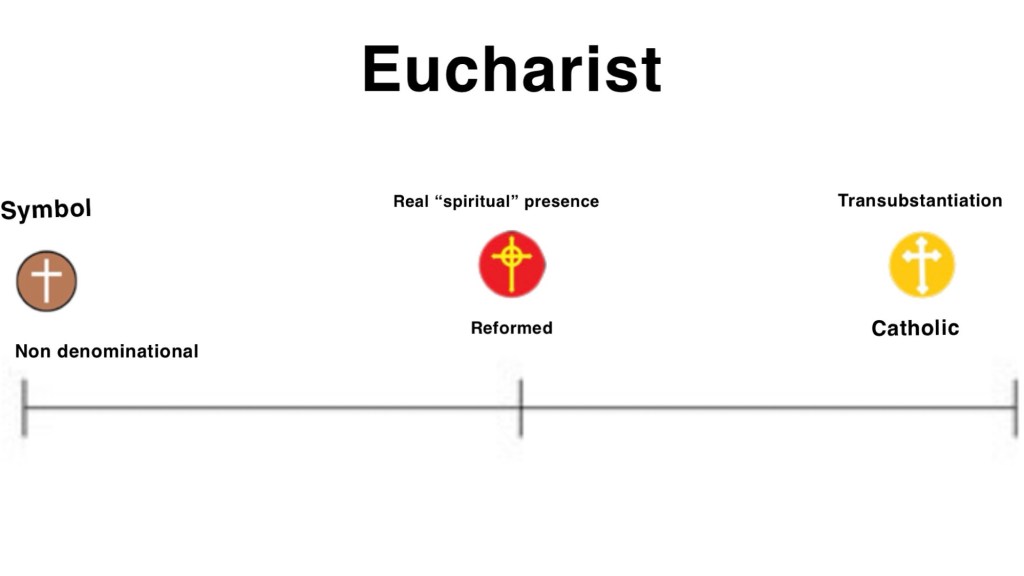
Above is a very oversimplified spectrum of different views on the Eucharist. I land right in the middle. I believe Jesus is truly present inside the lords supper, spiritually. In order to break this down we must go into John 6. In John 6 Christ has his first interaction with instituting the Eucharist. It starts in verse 27, Jesus says “Do not work for food which perishes, but for the food which endures to eternal life, which the son of man will give to you, for on him the father set his seal”. The Eucharist as John Calvin puts it in Book IV of the institutes of the Christian religion chapters 14 and 17, is a sign and a seal of the inward grace signified. What does that mean? The Eucharist is a repeated declaration and seal of one’s faith taken every week to remember Christ and what he did to save us. What this means is do i believe the bread and wine magically by itself can justify a person before the father such as the Roman Catholics ex opere operato? No (John 6: 28-29), but what it means is— it is evidence of the inward grace that has already taken place inside one’s heart and soul. So when one says “the Eucharist is necessary for salvation”, I can agree. Not that it is the factor that saves you, but it is essential evidence that the salvation has already taken place. I will admit I can also agree that the wordage “NECESSARY for salvation” can be misleading. So what I’d rather say is— it is the ordinary evidence of salvation. Let me make it clear, Yes I do believe the Eucharist is the ordinary means of grace and it is necessary for salvation. But does that mean i believe the almighty God is bound to the Eucharist? No, that’s why it is the ordinary means. So in an extraordinary circumstance God can work through that.
John 6:51 “I am the living bread that came down from heaven; if anyone eats of this bread, he will live forever; and also the bread which I will give for the life of the world is my FLESH” . The common argument I hear from the symbolic crowd is- “Jesus often used parables to describe himself, I am the door, I am the vine”. This fails to hold up here. Whenever Jesus was speaking in parables he was referring to his word. If in John 6:51 he said “this bread is my word” case closed it would be a parable and symbolic, but no he said “this is my flesh”. If we keep reading along John 6 in response to this admittedly tough teaching some of his disciples started to question him, so Jesus states “Truly, truly I say to you, unless you eat the flesh of the son of man and drink his blood, you have no life in yourselves he who eats my flesh and drinks my blood has eternal life, and I will raise him up on the last day. For my flesh is true food, and my blood is true drink. He who eats my flesh and drinks my blood abides in me and I in him. As the living father sent me, I will live because of my father, so he who eats me, will also live because of me. This is the bread which came down from heaven, not as the fathers ate and died. He who eats this bread will live forever” (John 6:52-58). At this point some of Jesus’ disciples started to leave him because they couldn’t wrap their heads around this teaching. If they misunderstood him wouldn’t you think he’d explain himself like he does with other parables? But no, he instead turns to his 12 disciples and says “Do you also want to go?” (John 6:67). Not only did he double down, he reinstated him self 3 times.
The Eucharist is a sign and seal of the inward grace signified and it is the ordinary evidence of salvation and the sanctification process in our walk with Christ. In terms of how we receive him in the bread and wine I will admit to mystery. Just as God worked through the resurrection and many other miraculous events he works through the Eucharist so we can truly receive him.


Leave a comment